AI Is an Enterprise Capability
AI increasingly appears across models, modalities, enterprise context, security controls, economics, general-purpose tools, SaaS features, point solutions, workflows, and agents. This article defines AI as an enterprise capability and proposes a working model built around models, context, controls, applications, operating responsibility, and value.
· Blaize Stewart · #enterprise-ai #enterprise-architecture #ai-capability #ai-governance #ai-adoption #operating-model #ai-architecture
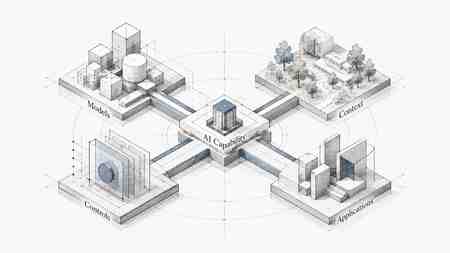
AI is still commonly discussed as though it were a technology that can be acquired, installed, and assigned to an existing part of the IT organization. That framing worked okay when "enterprise AI" meant a small number of machine learning projects owned by specialist teams. It works much less well now. In fact, it's falling apart. AI has spread across the technology estate. It appears in productivity software, SaaS products, custom applications, data workflows, developer tools, and agents. Each implementation may use different models, different data and context, different permissions, different controls, and different operating economics. The common element is no longer a single product or technical stack. It is an organizational ability that has to be developed and managed, and enterprise architecture already has a useful word for this kind of thing. It is a capability.
What capability means
The Open Group defines a capability as an ability possessed by an organization, person, or system. In enterprise architecture, capabilities are useful because they describe what the organization must be able to do without prematurely binding that ability to a particular product, platform, team, or implementation.
Security provides a familiar analogy. Enterprise security is an ability supported by related disciplines such as identity, network security, endpoint protection, monitoring, data protection, and recovery. Some concerns are centralized. Others are embedded inside applications, infrastructure, operations, or business processes. A firewall or identity provider may be an important component, but neither defines the security capability.
AI now has a similar profile. A practical working definition follows from that idea. An enterprise AI capability is the ability to select, combine, govern, operate, and measure models, context, controls, and AI-enabled applications so they can produce business outcomes within acceptable cost and risk.
That definition becomes useful when it can be inspected the way enterprise architecture inspects any other capability. The practical question is whether the enterprise possesses the characteristics required to use AI deliberately and repeatedly.
- Purpose, scope, and boundaries. AI should connect to defined business outcomes such as improving decisions, automating work, reducing cost, improving customer experience, or managing risk. Its scope includes models, enterprise context, AI-enabled applications, agents, copilots, and the controls required to operate them, while depending on adjacent capabilities such as identity, data, security, integration, and infrastructure.
- Constituent abilities and context. A broad capability can be decomposed into smaller abilities such as model selection and routing, context and knowledge management, evaluation, security and governance, cost management, application integration, agent management, and AI operations. Those abilities depend on information that is usable, authorized, current enough for the task, and traceable to an appropriate source.
- People, ownership, and lifecycle. Someone has to make decisions about approved models, data exposure, risk, evaluation, exceptions, operating support, and accountability. The capability also needs repeatable ways to identify use cases, test outputs, deploy solutions, monitor them, manage change, and retire obsolete components.
- Technology, controls, and measures. Models, gateways, context services, evaluation frameworks, observability, orchestration, and SaaS products can enable the capability. Security, privacy, compliance, cost, data policy, human oversight, and spending limits constrain how they can be used. The enterprise should also be able to assess maturity through measures such as evaluation coverage, deployment time, governance coverage, incidents, cost, adoption, and business value.
This capability view creates a layer above individual technologies. Models, context, controls, applications, operating responsibilities, and measures can change independently while the enterprise retains a definition of what it must be able to do.
Models are only one layer
Models to many appear as magic, and general term hides a growing amount of variation. Language models generate and analyze text. Vision models interpret images. Embedding and reranking models support retrieval. Multimodal and specialized predictive models solve other classes of problems. Those models vary by capability, cost, latency, deployment location, privacy characteristics, context limits, licensing, and hardware requirements. Some workloads can use a small local model. Others need a frontier model, and some applications may route work across several models.
Microsoft's current Well-Architected guidance for AI workloads reflects this breadth. It treats application design, application platforms, training data, grounding data, workload operations, testing, evaluation, and responsible AI as distinct design areas. The model remains important, but the workload around the model is what turns inference into a dependable application. An enterprise AI capability therefore needs a way to evaluate models by workload and to change those choices as models, prices, and requirements evolve. A model catalog or gateway may support that work. The capability is the enterprise's ability to make and govern those choices repeatedly.
Context is part of the capability
Model capability by itself says very little about what an enterprise AI system knows. Context supplies much of the useful specificity. It may come from the current prompt or session, an application or domain knowledge base, or shared enterprise data and records.
Context also has a chronology. A policy from three years ago may be valid historical evidence and still be wrong for the present. Useful context therefore requires freshness, provenance, versioning, ownership, and enough structure to determine when information applies. Access follows the context. A user may be allowed to know that a document exists without being allowed to retrieve its contents, while an agent may be allowed to summarize a record but not modify it. Enterprise context has to preserve identity, authorization, purpose, and data-handling rules as information moves through retrieval and generation. NIST's AI Risk Management Framework reinforces this contextual view. Its core functions of Govern, Map, Measure, and Manage operate across the AI lifecycle, and the Map function begins by establishing intended purpose, users, deployment context, impacts, assumptions, and limitations. Context is part of the system definition, not simply extra text inserted into a prompt.
The control surface is wider than the model
AI also introduces controls that cut across existing security, governance, architecture, operations, and financial practices.
Identity and authorization still matter, along with model selection, data permissions, context handling, privacy, evaluation, logging, human oversight, lifecycle management, and cost allocation. Agentic systems add another layer because models can receive permission to call tools and change external systems. OWASP's current GenAI work illustrates how broad that control surface has become, covering risks such as prompt injection, sensitive information disclosure, supply-chain concerns, unsafe output handling, excessive agency, misinformation, and unbounded consumption.
Cost has the same cross-cutting character. AI consumption can be driven by tokens, requests, model selection, retrieval volume, accelerator capacity, or software licenses. The economic control plane therefore has to connect usage with applications, users, business owners, and outcomes. An organization that cannot attribute AI consumption to the work producing it will struggle to manage AI as it spreads.
These controls rarely fit cleanly inside one existing IT team. Security owns part of the problem. Data teams own part. Application engineering, infrastructure, enterprise architecture, finance, legal, risk, and business owners all own other parts. Treating AI as a capability makes that distributed responsibility explicit.
AI appears in several application forms
General-purpose AI tools are becoming a normal class of enterprise software. Microsoft 365 Copilot, Claude, ChatGPT, and coding assistants can be used across many tasks without being tied to one workflow. Their governance questions center on access, information boundaries, acceptable use, licensing, adoption, and whether the productivity value justifies the cost.
Point solutions look different. AI may summarize documents in a claims process, rank recommendations, classify service requests, or extract information from forms. These implementations have narrower purposes and can often be measured against specific operational outcomes. Other AI arrives inside software the enterprise already owns, creating similar decisions around data exposure, permissions, retention, cost, risk, and value.
The enterprise AI capability has to accommodate all of these forms because they coexist. A general-purpose assistant may use vendor-managed models and context. A regulated point solution may use tightly controlled enterprise data and a private model endpoint. A workflow may combine models with deterministic code. Each belongs to the same capability even though the implementations may share very little technology.
Make the capability visible
The practical outcome of this framing is a capability map that exposes what the enterprise can and cannot do. An organization may have excellent access to models and weak evaluation, strong security controls and no coherent approach to enterprise context, or several copilots and no way to measure their value. Those gaps describe missing abilities rather than missing products, which makes them much easier to assign, prioritize, and improve.
The map also prevents implementation choices from becoming the definition of AI strategy. Some missing abilities can be addressed with standards or governance. Some require shared services. Others require changes in security, procurement, finance, risk, or workforce practices. A mature capability includes the ability to decide where AI is appropriate, how its impact will be measured, when a simpler technology is sufficient, and when an AI investment should be stopped.
Once those abilities are visible, architecture decisions become easier to evaluate. Shared technical services may be justified where repeated needs create leverage. Other parts may remain distributed across SaaS products, business applications, data platforms, and domain teams. Models will change. Vendors will change. Application patterns will change. The durable asset is the organization's ability to apply those changing technologies deliberately, safely, economically, and in ways that create measurable value.
Further reading
The Open Group TOGAF Business Capabilities Guide
NIST Artificial Intelligence Risk Management Framework