I Rebuilt My Childhood. In a Browser.
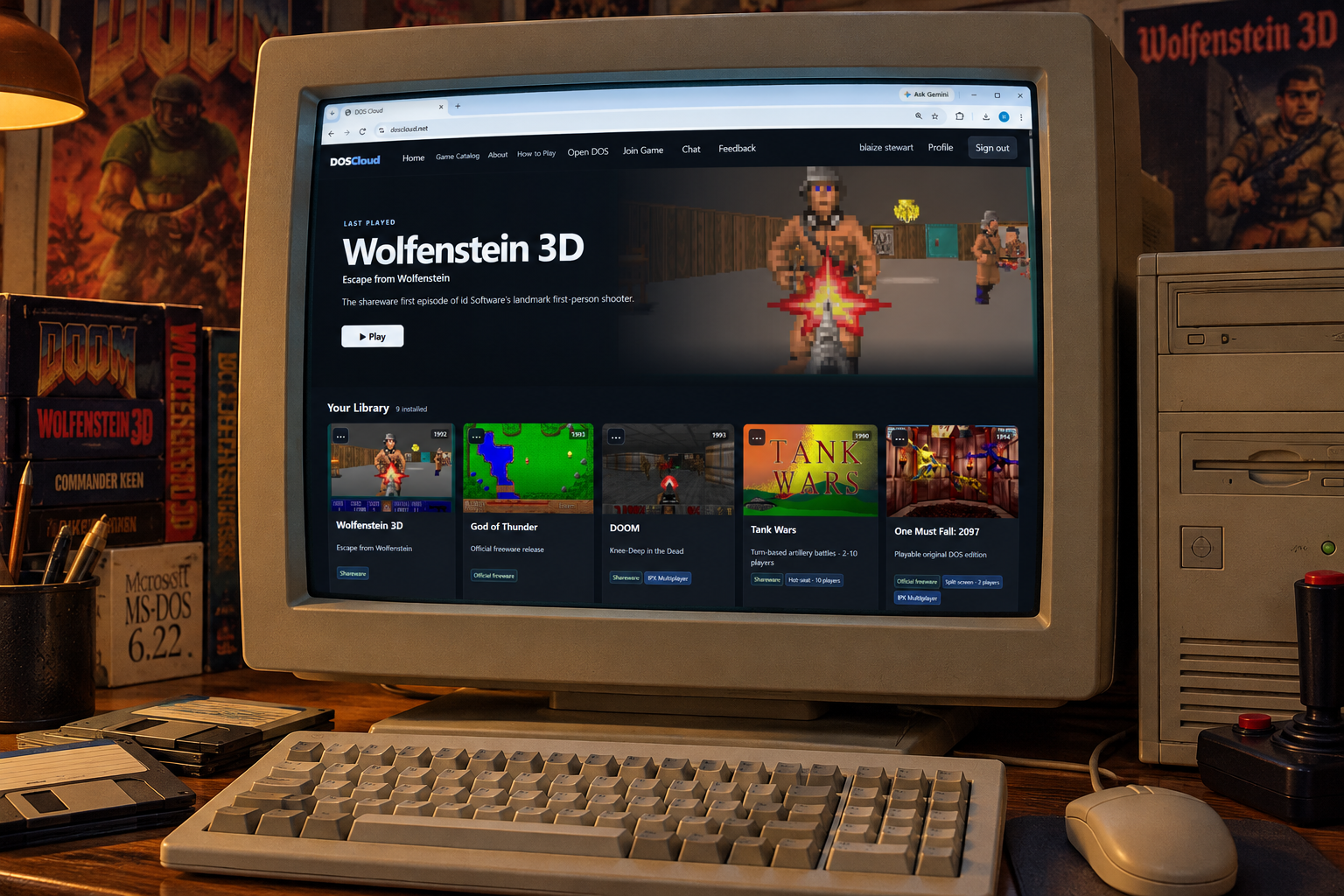
DOSCloud began as a fictional retro gaming company used to demonstrate application modernization. It became a real browser-based DOS platform combining centralized storage, IPX multiplayer, shared-console gaming, BBS door games, containers, and modern cloud architecture.
· Blaize Stewart · #doscloud #retro-gaming #software-architecture #application-modernization #cloud-computing #dos #bbs #software-engineering
Sometimes the best way to explore the future of software is to revisit its past.
For years, I've used a fictional company in conference presentations to illustrate the challenges of modernizing legacy software. The premise was a simple imaginary company that built and sold a cloud-based retro gaming platform, allowing customers to play classic DOS games online. The problem? Its infrastructure was built around an aging, on-premises monolithic application that needed to be modernized. The company needed to migrate to the cloud, break apart its monolith, adopt containers, introduce distributed services, and embrace modern application architecture and design patterns—all while keeping its decades-old games running. It was a fun way to demonstrate some very real enterprise architecture challenges like cloud migrations, application modernization, microservices, containerization, distributed systems, and the complexities of integrating legacy software with modern technology. Over the years, I built various prototypes and demos to bring parts of this fictional company to life.
They worked well for conference presentations, but I always wanted to take the idea further. What if I actually built the platform? So I did.
Introducing DOSCloud — https://doscloud.net
Now you can play classic DOS games directly in your browser, including multiplayer games and old BBS door games, without installing or configuring DOSBox locally. Getting there turned out to be quite an adventure.
Challenge #1: A Centralized DOS File System Over HTTP
I wanted a centralized file system that would support DOS applications running inside a browser. It is essentially, a file server that DOS games could interact with using modern web technologies. The idea was to separate the games and their data from the emulator, allowing game installations, user files, and saved games to be managed centrally. Surprisingly, this was easier than I expected. Once the file system was abstracted from the emulator, it became possible to bridge DOS file operations to a backend service over HTTP. One of the oldest operating environments, talking to a modern web-based file service. Pretty cool.
Challenge #2: Bringing IPX Multiplayer to the Internet
Remember configuring IPX networking to play Doom or Duke Nukem 3D with your friends on your high school's network in biology class? Now you can do that online. The emulator already had some of the underlying IPX capabilities, but supporting networking inside an emulator is quite different from coordinating multiplayer games across the internet. I needed a way to broker connections, manage game rooms, coordinate sessions, and allow people to launch DOS games from different browsers and join the same virtual network. So, I rebuilt the networking integration and added the backend orchestration necessary to make that happen. Games like Doom, Duke Nukem 3D, Heretic, and Quake were exactly the kind of multiplayer experiences I wanted to bring back.
Challenge #3: Multiplayer Games That Were Never Networked
Some of the best multiplayer DOS games were never designed for network play. Take Tank Wars, for example. It was a great game to play with friends, but everyone had to share the same computer. Could I turn that into an internet multiplayer experience without modifying the game itself? Simple answer? Yes. I built a shared-console system that streams the host's game screen to other connected browsers, allowing remote players to watch and share control of the same running game. Essentially, it makes local multiplayer games playable over the internet, even though the original software knows absolutely nothing about networking. No modifications to the game required.
Challenge #4: Bringing Back BBS Door Games
This was probably the most interesting challenge. If you grew up dialing into bulletin board systems, you might remember games like Trade Wars 2002, Legend of the Red Dragon, and Solar Realms Elite. I wanted to bring those experiences back, but without requiring users to connect to an actual BBS. The idea was to click a game on a website and launch an authentic DOS door session directly in the browser. That meant building a custom backend capable of running the original DOS executables, emulating the necessary DOS environment, managing player nodes, and handling the serial/FOSSIL communications that BBS door games expected. On the frontend, I implemented an ANSI terminal to render the game's output and relay keyboard input back to the running executable. The browser effectively becomes the terminal, while the backend provides the environment the original DOS door expects. It sounds straightforward until you start dealing with DOS memory models, execution contexts, interrupts, terminal control sequences, and 30-year-old software that assumes it's talking to a modem. Getting that working was an adventure all by itself.
Putting It All Together
Of course, underneath all of this was the original architectural exercise in building a modern application platform around very old software. I love docker, so I containerized the services that host backend APIs, session orchestration, storage, browser-based emulation, authentication, and a game catalog all had to come together into a cohesive application.
What started as a fictional company in a conference presentation had become a real platform. The remaining work was largely onboarding games, integrating everything, and working through the inevitable bugs and compatibility issues. There's still work to do. But it's been a fascinating exercise in applying modern architectural principles to software written decades before most of those principles became commonplace. And somewhere along the way, I realized I'd essentially recreated a piece of my childhood.
Will anyone actually play it? I have no idea. Did I spend entirely too much time building it? Almost certainly. Was it fun? Absolutely.
BETA TESTERS WANTED!
If you remember configuring AUTOEXEC.BAT, tweaking CONFIG.SYS, playing DOS games over IPX, or dialing into BBSes late at night, I'd love for you to give it a try. And if none of that sounds familiar, you're welcome too. Check it out at https://doscloud.net and let me know what works, what breaks, and what games you'd like to see added.
#DOSCloud #RetroGaming #SoftwareArchitecture #ApplicationModernization #CloudComputing #DOS #BBS #SoftwareEngineering