Stop Trying to Sell AI
AI has become ubiquitous in sales messaging at the same time that consumers are increasingly skeptical of AI-generated content and many enterprises are still struggling to convert AI activity into measurable returns. This article argues that vendors and internal technology teams should stop leading with AI and start with the business problem. AI should compete with automation, integration, process redesign, and simpler software on cost, quality, speed, and measurable value.
· Blaize Stewart · #enterprise-ai #ai-adoption #ai-roi #technology-strategy #sales #marketing #value-realization #enterprise-architecture
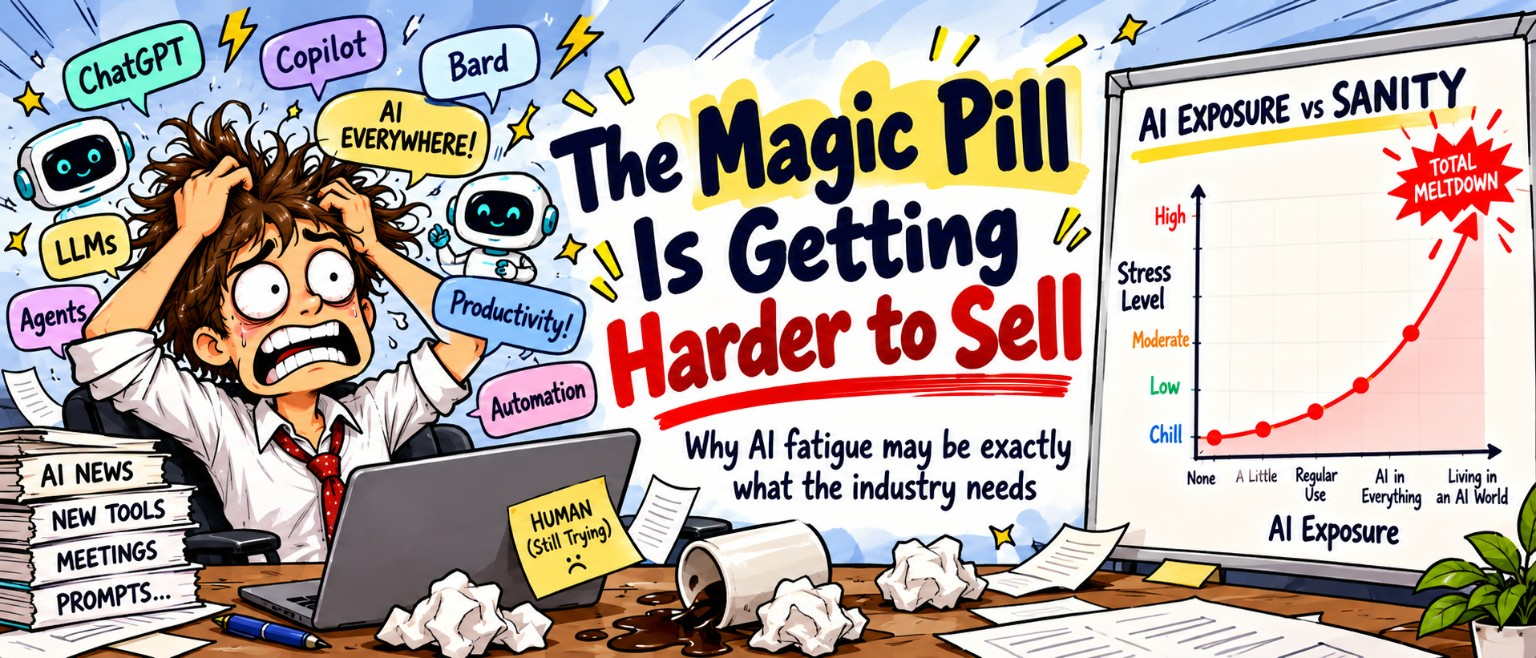
AI has seemingly become one of the easiest ways to make a sales pitch sound current, but it is also one of the fastest ways to make it sound like every other sales pitch. Email inboxes are full of AI assistants, AI agents, AI platforms, AI transformations, AI automation, and AI-powered versions of products that existed long before generative AI arrived, AI this, AI that, AI AI... LinkedIn is saturated with the same spam. The promise is usually some variation of a magic pill, add AI to a process and the process becomes faster, cheaper, smarter, or more productive. The volume is becoming part of the problem. Gartner found in 2026 that 49 percent of U.S. consumers believed generative AI had made the quality of available content worse. Among Gen Z and millennials, that number rose to 57 percent. In a separate survey, half of U.S. consumers said they would prefer to give their business to brands that did not use generative AI in consumer-facing messaging, advertising, and content. Those surveys impugning AI as a technology, they are a warning against AI as a marketing message. The market is beginning to push back against exaggerated AI promises, and for good reason. In 2026, the Federal Trade Commission reached a settlement with Air AI after alleging that the company had misled customers about business growth, earnings potential, and the performance of its services. While the case is a particularly egregious example, it illustrates a much broader problem in the AI market. Companies have become remarkably comfortable selling the promise of extraordinary results without establishing whether their products can actually deliver them. People already know AI exists. It's not magic anymore.
The more useful conversation starts somewhere else. Organizations have plenty of problems without inventing AI use cases. There are problems because they create measurable friction. They consume labor, delay revenue, increase errors, frustrate customers, or introduce risk. None of them is inherently an AI problem, but AI becomes interesting when the nature of the work makes other approaches difficult. AI can be part of the solution, but without a problem, it's a solution looking for a problem. The same principle should change how AI products are sold. Buyer do not need another promise that an agent will transform the business, rather they need to know what changes after the product is installed. The business buys an outcome. The organizations that ultimately extract the greatest value from AI will likely be those that spend less time searching for places to introduce it and more time understanding the problems that make their operations expensive, slow, unreliable, or frustrating. Once those problems are understood, they can evaluate the available solutions and determine where AI offers a genuine advantage.
Vendors would benefit from making the same adjustment in how they approach customers. The market has already seen countless demonstrations of what language models and AI agents can do, and another impressive example is unlikely to overcome the growing skepticism surrounding exaggerated claims. What customers increasingly want is evidence that a product addresses a problem they recognize, produces an improvement they can measure, and does so at a cost that makes economic sense. That requires vendors to understand the customer's business before attempting to sell the technology.
For all the complaints about AI fatigue, I suspect it could ultimately be one of the healthier developments in the industry. The enormous excitement surrounding generative AI has made organizations more willing to experiment, which has undoubtedly accelerated adoption and encouraged innovation. Unfortunately, it has also created an environment in which almost any idea can attract attention simply by incorporating AI. But ultimately, the businesses would be better served by abandoning the idea that AI is a magic pill capable of curing whatever ails an organization. The more credible approach is to begin with the problem, establish what meaningful improvement would look like, and demonstrate how the proposed solution achieves it. If AI is the most effective way to produce that result, its value should become apparent without having to sell the technology itself.
Further reading
Gartner Survey Finds 49% of U.S. Consumers Say GenAI Has Made Content Quality Worse